For growth-stage B2B software and AI companies
Stop doing more marketing.
Build the customer acquisition mechanism everyone else missed.
Achieve up to 7X ARR growth in 18 months.
You have a product customers value. We find out why more of the right buyers aren’t choosing it, and build and test a better way to win them.
Answer the diagnostic. Then book an Acquisition Bottleneck Review.
Customer acquisition is bigger than marketing.
Getting seen is one problem. Getting chosen is another.
A buyer might need evidence they can take to their boss, a compelling reason to switch, or a way to try without taking on too much risk.
More marketing activity won't necessarily remove those barriers.
Winning the customer means understanding what actually makes them act.

You may be solving the wrong problem.
Choose a symptom. See what we'd investigate.
WHAT YOU SEE
Paid isn’t converting.
WHAT YOU ASSUME
We need better ads.

WHAT WE INVESTIGATE
What is stopping the qualified buyer from acting?
What would have to change for them to act?
First, find the constraint. Then choose the fix.
A newsletter. A webinar. Another campaign.
Because that’s what everyone does.
That's Default Marketing: choosing familiar activities because they're standard in your category, rather than starting with what would make your buyer act.
The channels aren't the problem. Starting with them is.

The logo-swap test:
Could your closest competitor run the same campaign by changing only the logo?
A channel tells you where to reach buyers. An acquisition mechanism gives them a reason to act.
We identify the buyer motivations, proof, offer, timing and channels that could change a qualified buyer's decision. Then we design, build and test the acquisition mechanism around that insight.

You don’t have to outspend competitors to outmaneuver them.
We look for a focused investment with the potential for an outsized result. That might mean stronger proof, a different route to the buyer or a reason for customers to come to you.
Not a bigger activity list. A better bet.


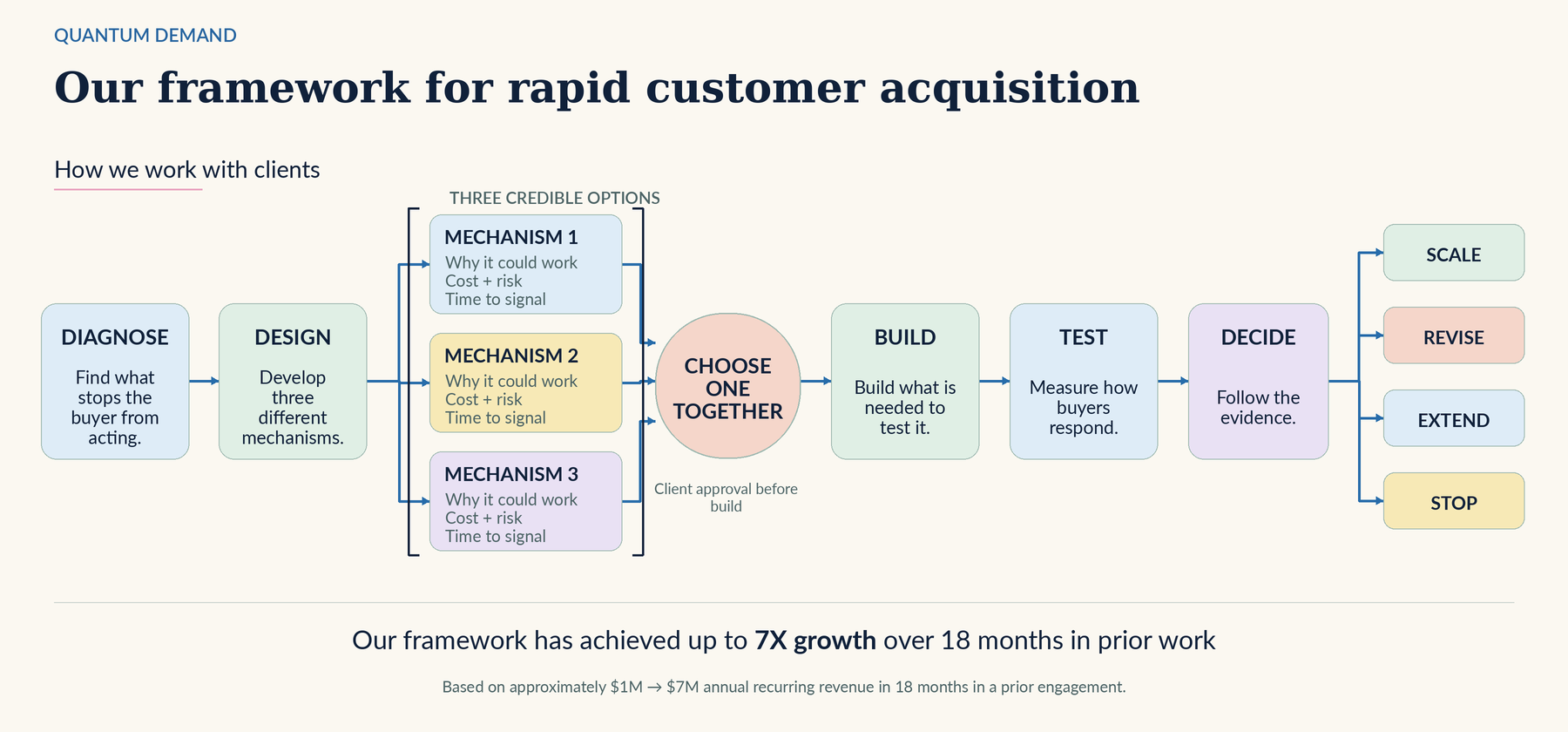
How we work with growth-stage companies
From an acquisition bottleneck to a mechanism built and tested with real buyers.
In 12 weeks, we identify what's stopping qualified buyers from acting, develop three fundamentally different ways to solve the problem, and choose one with you to build and test.
What you walk away with: A clear diagnosis, three evaluated options, an approved blueprint, test-ready assets, evidence from a live test, and a recommendation on what to scale, revise, extend, or stop.
Not another marketing plan. A tested way forward.


Palvi Verma
Founder, Quantum Demand
20+ years across B2B growth strategy, customer acquisition, and execution
I kept seeing the same expensive mistake: companies investing in more marketing without understanding why qualified buyers still weren't choosing them.
Over more than 20 years, I've worked across strategy and execution, taking growth ideas from the first question through implementation and commercial results.
What I've learned is that meaningful growth often comes from changing something more fundamental than a campaign, a channel, or a message. Sometimes it's the evidence buyers need. Sometimes it's a reason to switch. Sometimes it's an entirely different way to reach them.
That's why I built Quantum Demand: to find the acquisition problem worth solving, design a better mechanism, and actually put it to the test.
Questions before we start
What is a customer acquisition mechanism?
It is a coordinated way to change a qualified buyer’s decision. We connect buyer understanding with the proof, offer, timing and channels that could give that buyer a reason to act, then test the mechanism in the market.
Who does Quantum Demand work with?
We work with growth-stage B2B software and AI companies whose products create value but whose qualified buyers are not consistently taking the next step. The starting point is a specific acquisition problem worth investigating.
What happens in the 12-Week Build?
We diagnose one acquisition bottleneck, develop three fundamentally different mechanism options, choose one with you, and build and test it with real buyers. You leave with evidence and a recommendation on whether to scale, revise, extend or stop.
How do we get started?
Start with the complimentary Bottleneck Scan. Answer four questions about your business and where buyers get stuck, then schedule an Acquisition Bottleneck Review. A strategist reviews your answers, website and competitive context before the conversation.
BOTTLENECK SCAN
Before you spend more, find out what's actually stopping buyers.
No sales pitch. We'll review your business, examine where qualified buyers are getting stuck, and share initial insights tailored to your situation.
Complimentary review. Personally evaluated. No automated score.
What you'll walk away with
A clearer understanding of what may be holding back customer acquisition, insights specific to your business, and a better idea of what to investigate or test next.